

If you want to see how culture can flatline a giant—and then rocket it to a $3 trillion valuation, look at Microsoft.
From 2003 to 2013, under Steve Ballmer, Microsoft’s market cap stayed dead flat. The world had written them off. They were so irrelevant to the high-growth conversation that they weren't even included in the original FAANG stocks. They were the stuck giant, bogged down by ego.
When Satya Nadella took the helm, he didn't just look at the strategy and execution decisions; he also looked at the people decisions. Inspired by Carol Dweck’s Mindset, he realized his team was suffocating under their own egos. The employees behaved like know-it-alls. Nadella bet that shifting the predominant behavior toward a learn-it-all approach, professed by Dweck, could help make Microsoft relevant again and unlock growth.
He issued a challenge: shift from being "know-it-alls" to "learn-it-alls."
Curiosity replaced ego. Collaboration replaced internal rivalry. Leaders began reinforcing humility, learning, and shared success.
These shifts in behaviors altered cultural norms and outcomes. In just 12 years, he propelled an economic engine, increasing the company's value from below $500 billion to over $3 trillion.
Culture isn't a soft HR concept. It is the fuel for your strategy and the foundation of your execution.
You might not be a $3 trillion tech giant, but a cultural virus could be slowing your growth right now.
I see this in mid-market firms every day. A few years ago, I worked with a CEO of a $30M company. On the surface, things looked good. Revenue was climbing, but the organization felt stuck. Meetings were marathons of the same old issues. Some leaders carried the load while others quietly coasted.
The CEO told me, “People just need to step up.”
He was wrong. His people didn't need a pep talk; they needed a leader who stopped subsidizing chaos and complacency. Without realizing it, his leadership team was reinforcing the behaviors that were stalling their momentum.
Most leadership teams focus heavily on results. They push for higher revenue, stronger execution, and better financial performance.
While those goals matter, results are only the visible outcome of what is happening deeper inside the organization. The Results Pyramid helps leaders understand the chain reaction that cultivates the culture that drives performance.
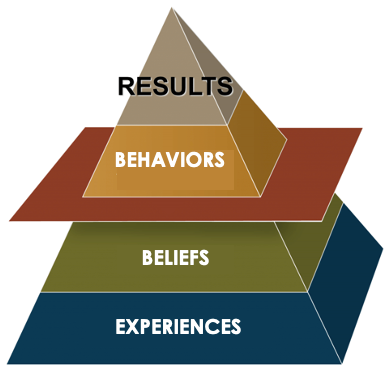
The framework is simple but powerful.
Experiences shape beliefs.
Beliefs drive behaviors.
Behaviors produce results.
If leaders want different results, they must start by building the right beliefs. You build the right beliefs by shaping the experiences people have inside the organization.
1 Connors, R., & Smith, T. (2011). Change the culture, change the game: The breakthrough strategy for energizing your organization and creating accountability for results. Portfolio/Penguin.
Every day inside an organization, experiences are shaping beliefs.
Recognition, feedback, leadership decisions, stories, systems, and even the behaviors that are tolerated all send signals about what truly matters. Employees are influenced by how leaders respond to success, failure, and conflict. Over time, they form beliefs, often at the subconscious level, about how the organization actually operates.
If experiences consistently align with the company’s ethos, values, and priorities, the culture strengthens positively. If they are inconsistent, the culture still strengthens, but in a negative way, leading to confusion, chaos, and complacency.
Employees begin asking themselves questions like:
The answers to those questions are not found in a handbook.
They are found in the experiences leaders create every day.
There are countless ways to create experiences that shape beliefs. One powerful approach leaders can adopt is strategic recognition. Acknowledging and celebrating people when they do things right is a valuable tool that many leaders overlook, yet it can have a profound impact.
Recognition might seem simple, but when done intentionally, it becomes a strategic tool for reinforcing the behaviors that drive performance.
Strategic recognition has three steps:
When recognition follows this pattern, employees begin to see exactly how their actions contribute to the company’s success. Over time, these moments reinforce the beliefs that drive high performance.
Unfortunately, many organizations unintentionally reinforce the very behaviors they seek to counter.
A high performer may deliver strong results but violate the company’s values in the process. Leaders tolerate the behavior because they fear losing the revenue the individual produces.
A leader can encourage empowerment, decision-making, and risk-taking. However, if that same leader harshly criticizes employees for making mistakes, it sends a conflicting message. This can lead employees to believe that it is better to play it safe or wait for someone else to make decisions or take initiative.
Over time, these experiences create a strong signal about what is genuinely valued, leading to the development of counterproductive beliefs. These beliefs can spread quickly among the team.
Never underestimate the power of your Founder Story. It’s not a history lesson; it’s a potent tool for strategy and people alignment.
Consider the discipline at Chick-fil-A. If you are one of the few chosen to be a local owner-operator, your final interview takes place in Truett Cathy’s former office. His portrait serves as a reminder of the company’s values. Your orientation doesn’t begin with a spreadsheet; instead, it starts at the original restaurant where it all began. You will spend several weeks immersed in Truett’s original vision of servanthood. Decades later, that single core value, servanthood, is ingrained in every “my pleasure” response and every operational decision they make. It is the foundation that drives their industry-leading execution.
Your story provides the emotional fuel your team needs. Why did you start this company? What was your vision? What ideals inspired you? What standards of excellence did you envision being non-negotiable?
Many CEOs think their "Why" is obvious. It isn't. If you don't repeat it, your team will fill the void with their own (often misaligned) motivations.
Leveraging your heritage transforms your team from “doing a job” to “fulfilling a mission.” This change turns a group of employees into a high-accountability team, motivated by a cause that safeguards your legacy.
For CEOs leading growing companies, the lesson is visceral: Your culture is already under construction. Whether you are the architect or just a bystander is up to you. Every experience you design, every behavior you reward, and every standard you refuse to compromise sends a signal about what truly matters.
If those signals are inconsistent, you are subsidizing a culture of chaos. But when you intentionally curate the right experiences, you ignite the Results Pyramid. You start shifting beliefs. Those beliefs drive the disciplined behaviors that create world-class execution and produce the results you’ve been chasing.
Strong cultures are not happy accidents. They are the product of clarity, relentless discipline, and leaders who refuse to tolerate mediocrity. When you define what winning looks like and drive accountability deep into your team, the transformation is massive.
You will stop being the bottleneck, allowing your organization to scale beyond just revenue. You will begin to scale leadership capacity and community impact.
That is the moment you reclaim what the grind stole from you: the freedom to lead, the fortune you’ve earned, and the fun of winning again.
If you suspect your organization may be subsidizing chaos and complacency, start with a simple leadership exercise.
Step back from the day-to-day grind and examine your culture honestly.
When culture becomes intentional, something remarkable happens.
Your culture stops billing you.
And starts paying you.
