

You’re walking through the office when you stop by a Project Manager’s desk to check on an important project. “We’re stalled,” he tells you, eyes fixed on a chaotic calendar. “The sub failed to deliver, and engineering missed the labor scope. My hands are tied.”
If you're like most founders, your first internal reaction is likely to be, "Here is another problem I have to face." You might be thinking, "When will this business finally get easier?" or "When will I experience the momentum I hear so much about?" You're feeling exhausted, and your family is frustrated by your absence during dinner, on weekends, and on vacations.
Many founders believe this is normal and just a part of being the leader of a growing company. They have grown to accept that these challenges are theirs to handle, having heard these excuses for so many years. It’s even more natural to want to fix it yourself. Especially if you have tried to delegate responsibility before and it did not work. So, you do what you’ve always done, you say, “Fine, I’ll take care of it.”
In that moment, you are acting on your instincts to advance the business. However, the blind spot in this approach is that you may be succumbing to the "Accountability Alibi."
The Accountability Alibi is the sophisticated mask an organization develops when activity and excuses replace ownership. It is the cultural habit of using busyness, complexity, and perceived obstacles to justify a lack of results. What makes this so frustrating is that your team isn't being lazy. In fact, they’re likely exhausted as well. They aren't necessarily avoiding work; they are stuck in a cycle of reaction and explanation that makes the accountability alibi a blind spot.
Many managers and founders believe that missed deadlines have valid reasons.
Here is the hard truth: Many of these explanations are valid. Real businesses encounter genuine challenges. However, to achieve growth at scale, it's essential to look beyond the validity of excuses and focus on the underlying causes. Profitable growth with less effort occurs when you stop accepting excuses as “out of our control” and teach your team how to identify the levers they can pull to not only solve today’s obstacles but also prevent tomorrow’s, even when those obstacles seem beyond their control.
The problem isn't that obstacles exist; it's that most people have been conditioned to look first for excuses rather than solutions.
In many growth-stage organizations, "busyness" is the ultimate sophisticated excuse. We call this the Accountability Alibi because it calls out activity for what it actually is: a way to avoid delivering results. This alibi moves the conversation from “hitting targets” to “working hard,” effectively hiding stagnant goals behind a shield of exhausted calendars.
Accountability is hard to find because people have become experts at passing the problems to the leader or, worse yet, accepting it as the status quo. This creates a Founder Trap where you spend your days working in the business, solving problems, and making decisions that your team should own, rather than strategically working on ideas that will help you leapfrog your competition and own your niche.
"Accountability is a personal choice to rise above one's circumstances, focus on what you can control, and take the steps necessary to drive results." — Roger Connors, The Oz Principle
The most common mistake leaders make is viewing accountability as a stick, a tool used to punish people when things go wrong. The Hidden Secret is that true accountability is a stimulus-and-response habit that helps the individual. It is a carrot, not a stick. It is something you do for your people, not to them.
To scale faster with less effort, pivot from being the "Enforcer" to being the "Coach." You don't mandate accountability; you foster it by creating an environment where ownership is the path of least resistance. This means when a team member brings you a problem, you don't solve it; you coach them to find the solution themselves.
At Rise Performance Group, we recommend the Above the Line model, borrowed from The Oz Principle, as the way to teach accountability. In any situation, a team member is either living above the Line or below the Line. Since most people are conditioned to look for the excuse rather than the solution first, the natural response is to live below the line.
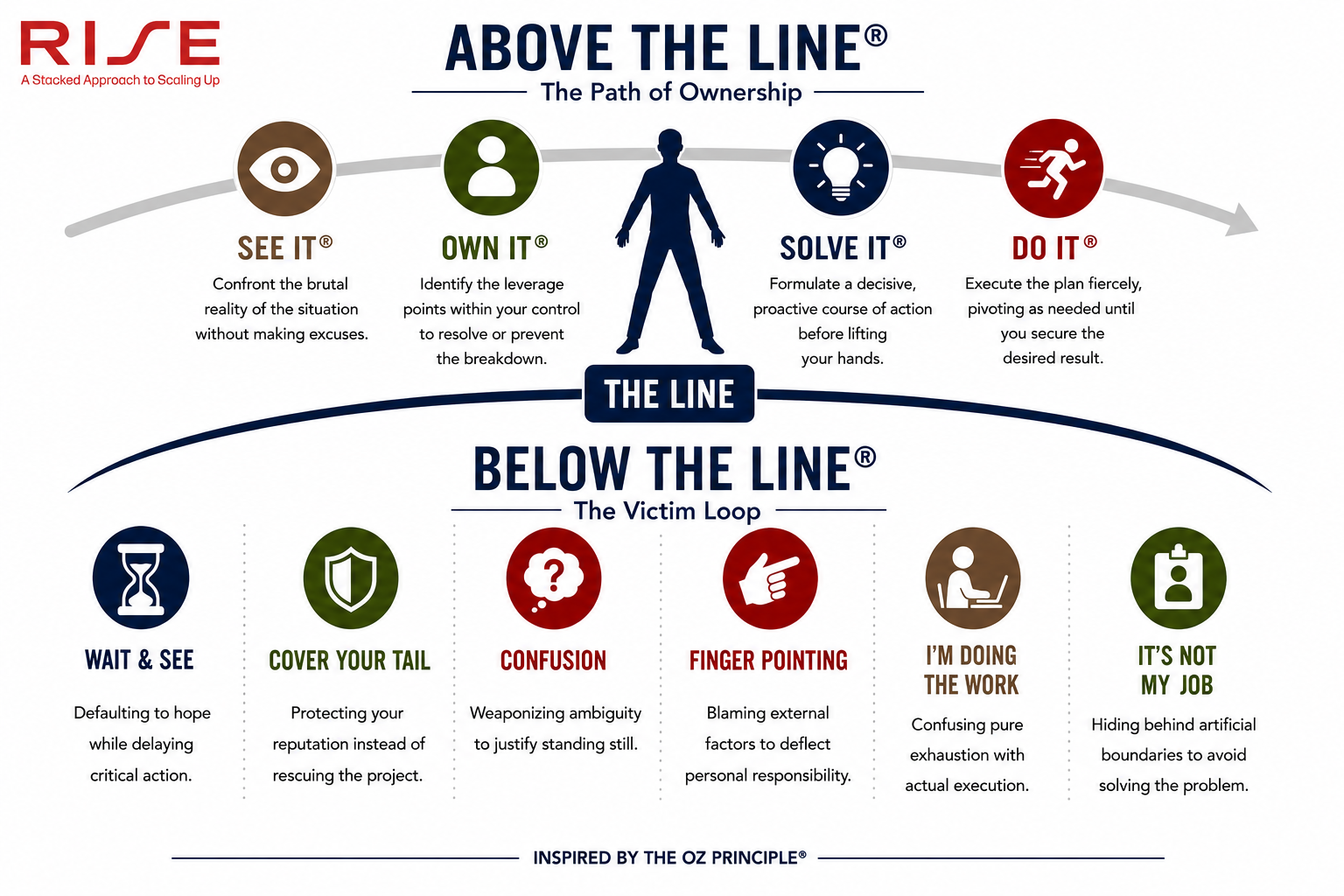
The ultimate CEO Realization required to reclaim your time and joy is this: "I am not doing this TO my people; I am doing this FOR them." Giving your team ownership is the ultimate act of servanthood.
Most people desire the "wheel" – they want control over their own outcomes, but they need to be taught how to drive.
I have yet to meet an employee who prefers a micromanager. Instead, most employees want to be trusted and empowered by their employers. They crave the autonomy to deliver results using their unique, God-given talents and abilities. However, for a founder to grant more autonomy, employees must earn their managers' trust by delivering results. Manager trust in the employee increases each time the employee lives above the line. Trust in the employee decreases each time the employee goes below the line.
It creates the ultimate win-win partnership when the employee sees that accountability and living above the line are the pathways to future empowerment and autonomy.
If you continue to tolerate accountability alibis, it will eventually become the bottleneck that stifles your growth. By fostering an environment where below-the-line thinking is the status quo, you are robbing your top performers of their autonomy. To leave a lasting legacy, you must build a team that self-organizes to solve problems and make decisions. This requires moving from the accountability alibi to a culture of see it, own it, solve it, and do it.
Identify three to five recurring problems or areas where results are off track. Use the Above the Line Coaching worksheet to work with the accountable leader. Help the accountable leader realize they can solve the problem and proactively ensure it does not happen again. Share success stories with others in the organization until above-the-line thinking becomes a habit.
Click here for the above the line coaching worksheet
