
The “Priority Paradox”: How Being Everywhere Means You’re Going Nowhere

You are running east, sprinting at a breakneck pace, pouring sweat, and burning through capital, all while wondering why the sky refuses to turn red. You want a sunset. But no matter how hard you run, no matter how much you motivate the team, you will never catch a sunset running east.
This is the hard truth confronting the CEOs of $10 million to $50 million companies across Texas and the Southwest every single day.
You built your company on sheer will, ambition, and a relentless refusal to say no to opportunity. That formula worked to get you here. But right now, that same ambition has become your anchor. Your calendar is jammed, your executive team is exhausted, and your growth has flattened, plateaued, or maybe you even feel stuck.
Welcome to the "Whack-a-Mole" stage of enterprise growth. It’s the messy middle where high activity masks low achievement, driven by a profound misunderstanding of what a priority actually is.
A priority is the most important goal that is expected to be achieved over the planning period. It is best measured by a percentage completion and a KPI measuring an improved business process.
“If you have more than three priorities, you don't have any.”
Jim Collins
The Profit Drainer: The "Priority Paradox": How the Urgent Hijacks the Important
Look at your Monday morning leadership meeting. It doesn't look like a strategic cockpit; it looks like a fire station.
Instead of looking quarters or years down the road, you and your executive leadership team (ELT) are trapped in the weeds. You are expediting delayed shipments, refereeing personal dramas between departments, and solving operational problems that the managers below you should have handled days ago.
Every week, the meeting follows the same painful pattern. You look at the list of key initiatives and quarterly rocks, the strategic plays meant to scale the business, and you find them perpetually stuck at "70% done."
To understand why this happens, we have to look at how you manage your most valuable asset: your time. Former U.S. President Dwight D. Eisenhower famously noted, "What is important is seldom urgent and what is urgent is seldom important." This concept, later popularized by Dr. Stephen Covey as the Urgent/Important Matrix, is the ultimate diagnostic mirror for a growth-firm CEO.

When you hit the $10M to $50M wall, it is almost always because the leadership team is spending too much time in Quadrant 1 (Crises) and Quadrant 3 (Interruptions)
The most significant casualty of this operational noise? Quadrant 2 (Important, Non-Urgent). Quadrant 2 is the space where high-leverage leadership lives. It is where you address the four critical questions that dictate your firm's ultimate success:
- How do I capitalize and build my firm's valuation?
- What strategy will help us achieve our vision and BHAG?
- Do I have the right executive team and culture?
- What unique processes will provide us with an outsized advantage?
If you do not protect your time to focus on these four pillars, you risk wasting years of execution on the wrong target.
This is the Dilution Death-Spiral. It is the massive profit drainer that occurs when you spread your limited resources, your cash, your time, and your best talent so thin that important priorities never cross the finish line. You aren't suffering from a lack of effort. You are suffering from a lack of focus. You are funding too many half-finished ideas, leaving your cash tied up in execution loops while your market window closes.
"The main thing is to keep the main thing the main thing." — Stephen Covey
The Hidden Secret: The Power of Focus
In our blog, Are you a Chief Everything Officer or a Chief Executive Officer you learned the importance of delegating daily operations and building an autonomous team. But once you free up that time, what do you actually do with it?
You invest it in Quadrant 2.
Scaling a business requires mastering Four Decisions: People, Strategy, Execution, and Cash. The Priority Paradox lives at the intersection of all four. When a company's strategy is muddy, its execution is not maximized, automatically dragging the CEO back into Quadrant 1 firefighting.
To break out of this trap, elite firms move from generic "focus" to the disciplined implementation of the One Page Strategic Plan (OPSP). The core of this discipline is identifying your Critical Number. The Critical Number is the one metric that matters most at the end of the quarter and defines how you measure winning.
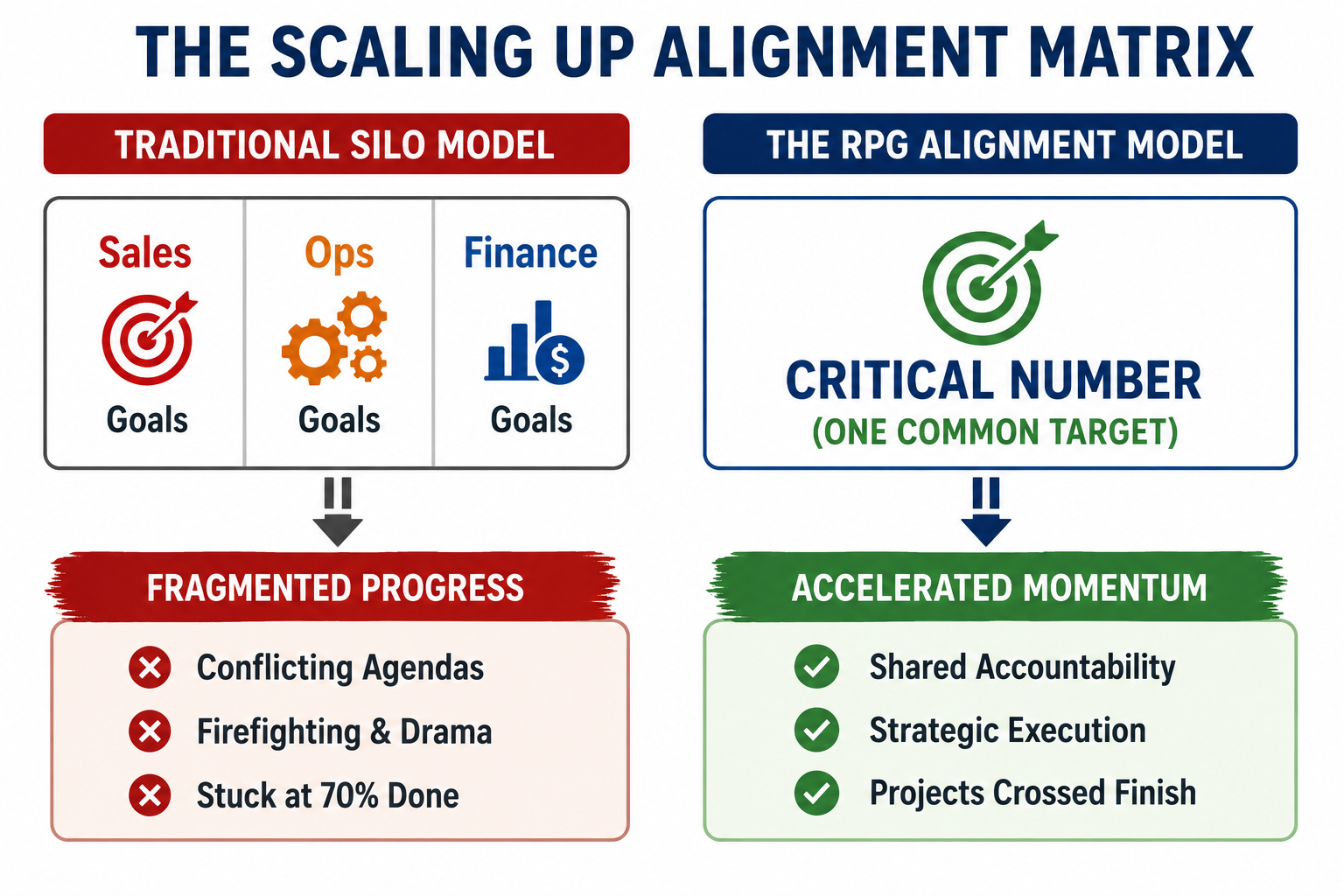
Selecting a Critical Number provides clarity and alignment to your strategy. If your strategy is flawed, no amount of hard work will rescue you. You will merely be racing east faster, pursuing a western horizon.
Why Your Executive Team Resists the "One Thing"
When I sit down with a CEO and their executive leadership team to build out their OPSP, the biggest pushback doesn't come from the frontline employees. It comes straight from the executive suite.
Your department heads have spent years being rewarded for building independent departments. They are functional experts, masters of sales, champions of operations, or wizards of finance. But when you force them to choose just one Critical Number for the enterprise, a hidden anxiety surfaces.
The resistance you see isn't a lack of commitment; it’s a lack of focus:
- The Burden of "Teaching the Business": Your executives are comfortable driving departmental results, but they often haven’t had time to translate the overall corporate strategy for frontline employees. They lack the time, skills, and tools to connect frontline employees' daily work to the big picture.
- The Skepticism of Peer Capability: Deep down, your VP of Sales doesn't believe the VP of Operations truly understands the market. Your CFO thinks the rest of the team lacks financial literacy. Because they lack trust that their peers can grasp the nuances outside their own domains, they have a bias for “staying in their lane" and focusing on their specific departments.
This friction happens because your team is still looking at the business through a straw. They are hiding in the comfort of their functional silos because stepping out requires them to think, lead, and teach like owners rather than just managers.
As the CEO, your role is to unify your team. You need to elevate everyone into Quadrant 2 alongside you. Show them that a high-performing team does not compete in five separate races; instead, they clear the path for the single most important runner. When the entire executive team shares the same Critical Number, silos dissolve, finger-pointing ceases, and departmental conflicts disappear. Accountability then becomes a collective responsibility.
Laser Focus in Action: Aligned Executive Priorities
Consider the radical transformation that occurs when a growth firm stops the madness, cuts out the noise, and rallies around a single enterprise outcome on their OPSP, such as a Gross Profit Dollar Target, EBITDA, or Operating Cash Flow.
Once that single Critical Number is locked in, it creates a unified lens that re-aligns the priorities of every individual executive:
- The VP of Sales completely shifts how they evaluate opportunities. They stop chasing top-line revenue at all costs and begin prioritizing profitable revenue. They intentionally target deals that can be easily implemented, knowing that reducing delivery costs and maximizing client satisfaction are the only ways to protect margins.
- The Vice President of Operations shifts from a defensive stance to a more collaborative approach. Rather than viewing the sales team as incompetent, they start listening carefully to which promises would effectively drive sales, what customers truly need, and the factors that genuinely contribute to client satisfaction. Operations begins to recognize the importance of helping the company differentiate itself as unique and valuable.
- True Sales and Operations Collaboration becomes the standard. Sales focuses on selling exactly what Operations is expert at delivering, and Operations builds the capacity to deliver what Sales can win at the highest client satisfaction levels and highest gross margins.
By narrowing the playing field to an enterprise outcome, you eliminate the natural friction between functional silos. The daily firefighting dies down because the executive team is no longer running separate races; they are collaborating to clear the track for a single, highly profitable victory. That is the true power of clarity.
The Solution: The Cascading Value Matrix
When you hear these objections in the boardroom, your job as the CEO isn’t to argue with them; it’s to give them a translation device.
Executives resist the "One Thing" because they try to teach abstract, high-level strategy to people who live in a world of daily tasks. If you tell a machinist on the shop floor or an account manager in the field that the company's priority is to hit a profit number, they will most likely nod politely and then go right back to doing exactly what they did yesterday. They don't know how to connect their daily sweat to your financial goal.
To break this bottleneck, we use a framework called the Cascading Value Matrix. It moves your leadership team from an organizational chart built on silos to a horizontal value stream built on cause-and-effect. It gives your VPs the exact blueprint they need to confidently "teach the business" without needing to give their teams a degree in corporate finance.

This matrix forces your executive leadership team to align on three distinct operational levels:
Level 1: The Enterprise Outcome (The "What")
This is your corporate Critical Number, anchored squarely in your Quadrant 2 strategic focus. It is the overarching metric that defines winning for the entire company this quarter (e.g., Gross Profit Dollars).
Level 2: The Functional Drivers (The "How")
This is where your executives stop operating in their departments and start leading the enterprise. Your VPs don't need to teach other departments' metrics; they just need to identify the primary driver within their own area that directly moves the Level 1 Critical Number.
- The VP of Sales owns Gross Profit Dollars Booked.
- The VP of Operations owns earning revenue and gross profit dollars.
When they see their individual drivers sitting side-by-side on the same matrix, they realize their metrics are codependent. Skepticism evaporates, and they begin solving problems collectively instead of pointing fingers.
Level 3: The Frontline Actions (The Daily Scoreboard)
This is the ultimate antidote to the resistance of "teaching the business." Your frontline employees don't need to understand gross margin calculations; they just need a visible, daily scoreboard for their specific Level 3 action. If a frontline worker can look at a scoreboard on the wall and see a green or red indicator for their daily production, they are actively driving your enterprise valuation, and your executive has successfully taught the business.
The Strategic Priority Audit
To determine if your business is running east in search of a sunset, evaluate your current operational reality against the audit below.
Pay close attention to where the tension lives in your organization. In a misaligned firm, the pressure is upside down: the executive team is stressed, firefighting, and carrying the weight, while the middle managers and frontline employees are relatively relaxed. In an aligned, professionally run firm, that dynamic flips. Because clear systems and scoreboards are in place, the executive team has the strategic breathing room to guide the company, while the middle and frontline managers feel the healthy, productive tension of owning their outcomes and being challenged to raise the bar.
The Strategic Priority Audit
From Silos to Strategic Speed: A Real-World Transformation
This isn't just theory. Consider the leadership team of a middle-market healthcare company that was struggling to execute its strategic growth initiatives.
On the surface, everything looked fine. In their quarterly meetings, the team members appeared to get along well—they smiled, nodded, and played nice. But below the surface, a lack of trust bred politics, passive-aggressive behaviors, and departmental drama that ate up hours of productivity every week. Because they were trapped in artificial harmony, critical initiatives lost momentum, and execution slowed to a crawl.
The leadership team did the hard work of building vulnerability-based trust and adopting a structured framework for healthy debate. They committed to eliminating the polite silence.
The transformation was stark. By reducing artificial harmony, they elevated the quality of debate, leading to sharper decisions and earlier detection of potential roadblocks. They clarified who was accountable for what and by when, which solidified peer-to-peer accountability. The ultimate result? Execution speed surged, and they successfully delivered strategic initiatives that had been stuck in limbo for over a year. They stopped paying the tax and started accelerating their results.
Stop Paying the Tax
If you are tired of a lack of execution, if you are sick of the executive team drama, and if you are ready to leave a legacy business that can run smoothly without you pulling the levers, it is time to stop playing it safe in your leadership meetings. Stop settling for fake agreements. Your company's growth, your freedom as a leader, and the ultimate value of your enterprise depend on your willingness to cultivate a healthy, aligned, and beautifully disruptive culture of conflict.
Your Next Step
Do not let another executive meeting end with polite nods and silent disagreement. Take action immediately to drive accountability deep into your team.
At your very next strategic off-site, pull out the tools from The Five Dysfunctions of a Team Field Guide. Run a targeted, healthy conflict exercise to call out unspoken issues, break down departmental silos, and start minimizing the impact of the artificial harmony tax once and for all.
Want to accelerate your results and scale your leadership team with absolute clarity? Reach out to Rise Performance Group today to discover how we help mid-market CEOs build high-accountability cultures.
